Do you have a novel ready to pitch to a publisher? Do you love reading? Do you like to meet authors face to face? Choc Lit, a multi-award-winning publisher of commercial fiction in a wide range of genres with a fan base consisting mainly (but by no means exclusively) of women is going on tour this year, visiting many UK libraries and hoping to meet lots of readers and writers.
The first stop on the tour is Exeter Central Library of 8th April, where editors and authors (including Linda Mitchelmore, Victoria Cornwall, Evonne Wareham and I) will be talking about our work and inviting questions from the audience.
It should be a fun event with plenty of opportunities for audience participation. There will be prizes and presents and of course chocolate to take home.
Full details are on this link: http://www.choc-lit.com/choc-lit-on-tour/
No PayPal account? No problem! Just contact Choc Lit direct at info@choc-lit.co.uk and say you'd like to come.
Welcome!
I've set up this blog so that all my friends, relations and colleagues in the world of writing can keep up to speed with what I'm doing - from now on, I'll never have to say sorry for not keeping in touch.
Or anyway, that's the plan.
So do please link up with me on Facebook and Twitter - https://www.facebook.com/margaret.james.5268 and https://twitter.com/majanovelist
You can find my novels as digital downloads on Apple iTunes, Kobo, Kindle and Nook, and most are available as print paperbacks, too.
Tuesday, February 28, 2017
Tuesday, January 3, 2017
Victoria Cornwall - a historical novelist new to Choc Lit, the multi-award-winning publisher of women's interest fiction
Today, it's a great pleasure for me to chat to Victoria Cornwall, whose first historical novel for Choc Lit is published this month.
Thank you, Margaret, for having me on your blog today.
You're very welcome, Victoria. Do have a chocolate cookie and a cappuccino! Now - remind me how we first met?
That was in early 2015 when I joined the Romantic Novelists’ Association. At the
time, I was pursuing my dream of signing with a traditional publisher. Luckily, I
signed with the award-winning publisher of women’s fiction, Choc Lit, the
following year. Not bad for someone who was not able to take English Literature
as a subject in school.
It's not bad at all! What were you doing before you became a novelist?
Up to this point, my life had been very different. I grew up
on a farm in Cornwall and my childhood
was filled with chickens, cows, orphaned lambs, cats, dogs and an albino rabbit
named Benjamin.
At 17, I headed for the big city, trained as a nurse and returned
to Cornwall to spend the next 20
years nursing. The role held great responsibility, but it was also very
humbling to witness ordinary people showing great courage in traumatic or
difficult situations. It certainly gives one a new perspective on life.
What sparked your interest in writing fiction?
A change of career finally allowed me the time to write, something
I had always wanted to do. I wrote in secret and didn’t tell my extended family
until much later. By then I had self-published two novels and they had both
been nominated by InD’tale magazine for the RONE Indie
and Small Published Book Award, U.S.A.
I was also fortunate to be short-listed for the New Talent Award at the Festival of Romantic Fiction, 2014, U.K.
I came to realise that I didn’t need to pass an exam in English Literature in order to tell a
good yarn.
Who or what inspires your writing?
I guess all writers draw on their experiences of life. For
me it’s my experience of Cornish rural life, witnessing the emotions and
reactions of ordinary people to extraordinary events, and I'm also inspired by my love of history and
romantic fiction.
Tell us a little about The Thief's Daughter?
My third book, The Thief’s Daughter, is my debut novel with
Choc Lit and my first traditionally published book. It is set in 18th century Cornwall ,
when England is
crippled by debt and poverty and smuggling prospers. Jenna has been brought up
in a family of thieves; however, after being terrified by a thief-taker’s
warning as a child, she has resolved to be good. After being saved from a
brutal marriage by her brother, Silas, she finds herself a widow who owes him
her life. So when Silas asks her to pay his creditors and secure his freedom
from the debtor’s prison, Jenna feels unable to refuse and finds herself
entering the secretive and dangerous world of the smuggling trade.
Jack Penhale has spent years hunting down the smuggling gangs who plague
The Thief’s Daughter is about divided loyalties, family ties
and love, but for me it represents so much more. It is a goal achieved and a dream
come true.
It sounds brilliant, Victoria! I'm looking forward to reading The Thief's Daughter very soon and wish you all the luck in the world with this lovely book, which is available here:
https://www.amazon.co.uk/Thiefs-Daughter-Choc-Lit-ebook/dp/B01MT550QT/ref=sr_1_2?s=digital-text&ie=UTF8&qid=1483445971&sr=1-2&keywords=the+thief%27s+daughter
Website: www.victoriacornwall.com
Twitter: @VickieCornwall
Facebook: www.facebook.com/victoriacornwall.author
Instagram: www.instagram.com/victoria_cornwallx
Tuesday, October 4, 2016
Traditional, independent - which is right for you?
Most of my writing life, I've been traditionally (or, if you like, commercially) published. This has been the case with all my longer, novel-length fiction. I'm currently published by a brilliant company which has done me proud in every respect - production, publicity and marketing.
But, when my writing partner Cathie Hartigan and I decided to write some guides for creative writing students, we chose to go independent.
Why?
It would be quicker.
Once we had written the first book, had had it read by several of our writing friends, including our own students, and we had edited it ourselves, it was ready to publish. But, if we'd sent it to a literary agent, who would then have had to find a publisher, who would then have had to find a publishing slot for it, we might have been looking at three years or even more before the book actually became available.
We would have total control over the products.
We could and we did design and produce the covers. We chose the layout. We typeset the print books in the format we thought was most appropriate - in large type with wide margins, which left plenty of white space for the students to make notes on the books themselves, which we have learned some of them do!
We would be paid promptly every month.
A traditional/commercial publisher's accounting system is usually set up to pay authors royalties every six months. This means that the payment on a book which earns a specific royalty on - for example - 3rd September will probably not reach the author until three months after the end of the publisher's accounting period. So, if the accounting period happened to be September to March, the author would not be paid anything until round about the June of the following year. It's a long time to wait!
We would earn more money.
As the publishers of our books, we would receive 100% of any royalties, rather than a percentage negotiated with a traditional/commercial publisher.
We could set the price.
Traditional/commercial publishers have to make a profit. They're not charities. They have staff to pay, warehousing to find, publicity and marketing to organise. All this costs money. But independent authors are working for themselves and - if they have the time and are prepared to learn the skills - they can do all the jobs for which traditional/commercial publishers have to pay third parties.
We could change the price.
A traditionally/commercially published author has no say in what a book will cost. What if the author feels a book has been priced so highly that nobody will buy it? Or priced so low that the royalty for the author will be negligible? We started promoting our books at a price we thought was fair to readers and to us, and so it has proved to be. But if we ever want to change our prices - for example, put the books on special offer for a time - we can do so without reference to anyone else.
It would be a challenge.
We like a challenge! We understand that presenting your book to the world can be scary. What if nobody buys it? What if everyone hates it? What if, after the reviews start coming in, it becomes apparent that it's a really bad book? It's a risk all independent authors have to take. But, when it works, it's great. As I type, both our guides to creative writing have received good reviews and they sell in gratifying quantities - not brilliantly, but consistently. The print version of The Creative Writing Student's Handbook sells particularly well.
So thank you, Amazon KDP, for making this possible.
https://www.amazon.co.uk/Short-Story-Writers-Workbook-CreativeWritingMatters-ebook/dp/B00UC541MQ/ref=tmm_kin_swatch_0?_encoding=UTF8&qid=1475587837&sr=1-2
https://www.amazon.co.uk/Creative-Writing-Students-Handbook-CreativeWritingMatters-ebook/dp/B00JS5LQ4M/ref=sr_1_3?s=digital-text&ie=UTF8&qid=1475589855&sr=1-3
Monday, September 12, 2016
Christmas is coming...
A Christmas Celebration
Christmas is coming, so this means there is lots to do - presents to buy, nativity plays and various church services to attend, beds to make up, travel arrangements to be made, food to order - the list goes on!
Cathie, Sophie and I can help you get in the right frame of mind!
Our Christmas Celebration is a collection of short stories reflecting all the various aspects of Christmas, which of course means different things to different people.
What about you - will you be going to St Paul's Cathedral, like the characters in one of our stories? Or seeing a local nativity play? Or trying to get used to the presence of a new family member or a partner's relations and feeling a bit awkward about it? Or trying to choose a perfect present? Or going on holiday? Or maybe feeling sad because Christmas isn't always a great time for everyone? What about people who tend to get left out, are lonely, isolated, or positively antisocial? How do they cope with watching other people have the time of their lives? Our stories will suit your mood, whatever form it takes!
We've also included a few quizzes and puzzles, some easy, some not so easy, but all the answers are in the book.
We feel Christmas is a time to think positively and look to the future, even if you can't wait for the holiday season itself to be over, for the shops to be open again, and to meet the challenges of a brand new year.
The book is available as a digital download or an attractive paperback - stocking filler? https://www.amazon.co.uk/Christmas-Celebration-Stories-Quizzes-Puzzles-ebook/dp/B013ZZN6IE/ref=sr_1_10?s=digital-text&ie=UTF8&qid=1473678800&sr=1-10
Sunday, June 26, 2016
Exeter Novel Prize
The Exeter Novel Prize is fast becoming one of the most prestigious writing competitions in the UK, or rather the world. The fourth annual competition is open to entries, so could you be our fourth winner, joining a host of now-published and soon-to-be-published winners, shortlisters and longlisters?
http://www.creativewritingmatters.co.uk/2015-exeter-novel-prize-award-ceremony-and-judges-reports.html
Provided you are not currently under contract to a commercial publisher or represented by a literary agent, you are eligible to enter. We welcome authors of self-published novels, too.
You can find out more by accessing this link on the CreativeWritingMatters website: http://www.creativewritingmatters.co.uk/2016-exeter-novel-prize.html
Sunday, April 24, 2016
Busy in the Library
You've always thought libraries were quiet places full of sharp-nosed, grey-haired librarians glaring suspiciously at people who actually dare to touch their books? You didn't really, did you? Well, if you ever did, an afternoon spent at Exeter Central Library celebrating the launch of Libraries Unlimited would have changed your mind forever. Here are some of the authors and staff at the event.
Libraries Unlimited is a new initiative dedicated to involving the whole community in reading and information-sharing. Devon is proud to be part of this new way of involving local communities and making everyone feel welcome in a public library.
Yesterday was a joyous occasion. The brilliant, multi-award-winning novelist Michael Morpurgo made an impassioned case for our free public libraries to be seen as just as important to us all as our free National Health Service, and we - authors, readers, friends of libraries and library users in general - all agreed with him.
I'm a member of a team of authors who are collectively Creative Writing Matters, and here is what we have to say about libraries in the community. https://www.youtube.com/watch?v=ZzMQnlKSpZg&list=PLL0HI7pPaaFtauVFJQKvNr7QgV1oK9jtD&index=12
So use your libraries, people! They're there for you. You don't even have to borrow books, even though (speaking as a novelist) it would be nice if you do. Go there to use the free wi-fi, have a bun in a library cafe, meet friends, do some work, have a little doze and generally enjoy being in a literary space. You'll love it, I promise you!
Sunday, March 13, 2016
Exeter Novel Prize
Well, yesterday was the day, and what a day!
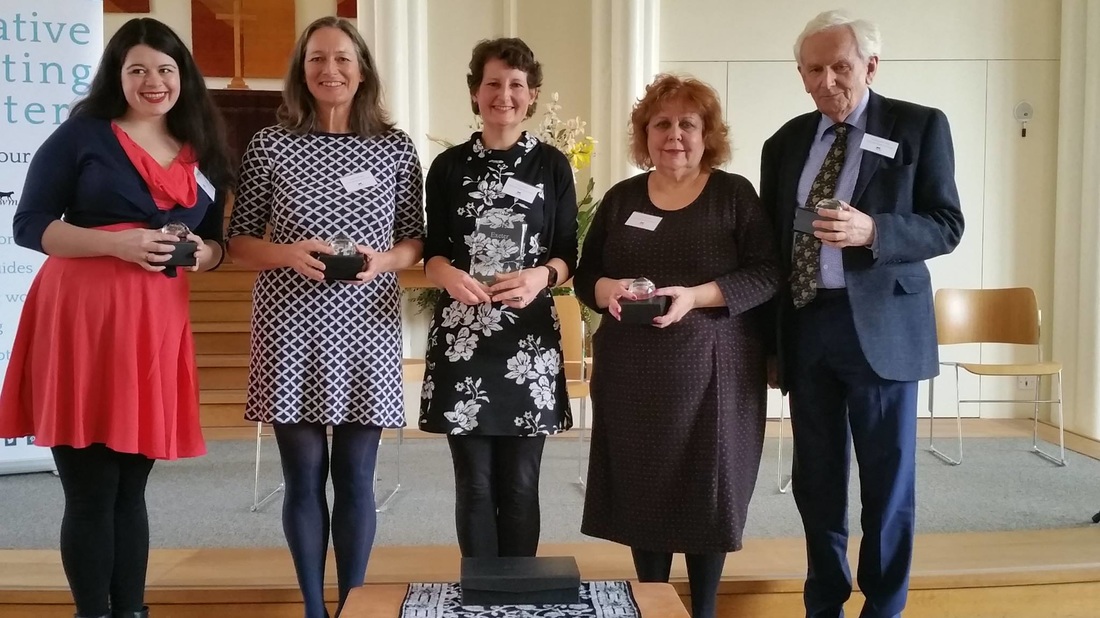
We all convened at the historic St Stephen's Church to find out who had won the third Exeter Novel Prize. It's always a tense time, waiting to find out who has won a competition. But, before we announced the winner, we had to make the point that all six of our shortlisted authors were winners because being in the last six out of 340 surely makes you a winner?
So - huge congratulations to Lucy Welch, Lucy Ayrton, Louise Mangos, Lizzie Lamb, Mark Dlugash and Christopher Holt for doing so well, and an additional cheer for Lucy Welch who was the winner of winners.
There is a full report and also a lot of pictures on the CreativeWritingMatters website, so do please pop over and take a look?
www.creativewritingmatters.co.uk
Here are the shortlisted authors. Left to right: Lucy Ayrton, Louise Mangos, Lucy Welch, Lizzie Lamb and Christopher Holt. Mark Dlugash couldn't join us because he was in Los Angeles. Maybe next year, Mark?
Subscribe to:
Posts (Atom)