You've always thought libraries were quiet places full of sharp-nosed, grey-haired librarians glaring suspiciously at people who actually dare to touch their books? You didn't really, did you? Well, if you ever did, an afternoon spent at Exeter Central Library celebrating the launch of Libraries Unlimited would have changed your mind forever. Here are some of the authors and staff at the event.
Libraries Unlimited is a new initiative dedicated to involving the whole community in reading and information-sharing. Devon is proud to be part of this new way of involving local communities and making everyone feel welcome in a public library.
Yesterday was a joyous occasion. The brilliant, multi-award-winning novelist Michael Morpurgo made an impassioned case for our free public libraries to be seen as just as important to us all as our free National Health Service, and we - authors, readers, friends of libraries and library users in general - all agreed with him.
I'm a member of a team of authors who are collectively Creative Writing Matters, and here is what we have to say about libraries in the community. https://www.youtube.com/watch?v=ZzMQnlKSpZg&list=PLL0HI7pPaaFtauVFJQKvNr7QgV1oK9jtD&index=12
So use your libraries, people! They're there for you. You don't even have to borrow books, even though (speaking as a novelist) it would be nice if you do. Go there to use the free wi-fi, have a bun in a library cafe, meet friends, do some work, have a little doze and generally enjoy being in a literary space. You'll love it, I promise you!
Welcome!
I've set up this blog so that all my friends, relations and colleagues in the world of writing can keep up to speed with what I'm doing - from now on, I'll never have to say sorry for not keeping in touch.
Or anyway, that's the plan.
So do please link up with me on Facebook and Twitter - https://www.facebook.com/margaret.james.5268 and https://twitter.com/majanovelist
You can find my novels as digital downloads on Apple iTunes, Kobo, Kindle and Nook, and most are available as print paperbacks, too.
Sunday, April 24, 2016
Sunday, March 13, 2016
Exeter Novel Prize
Well, yesterday was the day, and what a day!
We all convened at the historic St Stephen's Church to find out who had won the third Exeter Novel Prize. It's always a tense time, waiting to find out who has won a competition. But, before we announced the winner, we had to make the point that all six of our shortlisted authors were winners because being in the last six out of 340 surely makes you a winner?
So - huge congratulations to Lucy Welch, Lucy Ayrton, Louise Mangos, Lizzie Lamb, Mark Dlugash and Christopher Holt for doing so well, and an additional cheer for Lucy Welch who was the winner of winners.
There is a full report and also a lot of pictures on the CreativeWritingMatters website, so do please pop over and take a look?
www.creativewritingmatters.co.uk
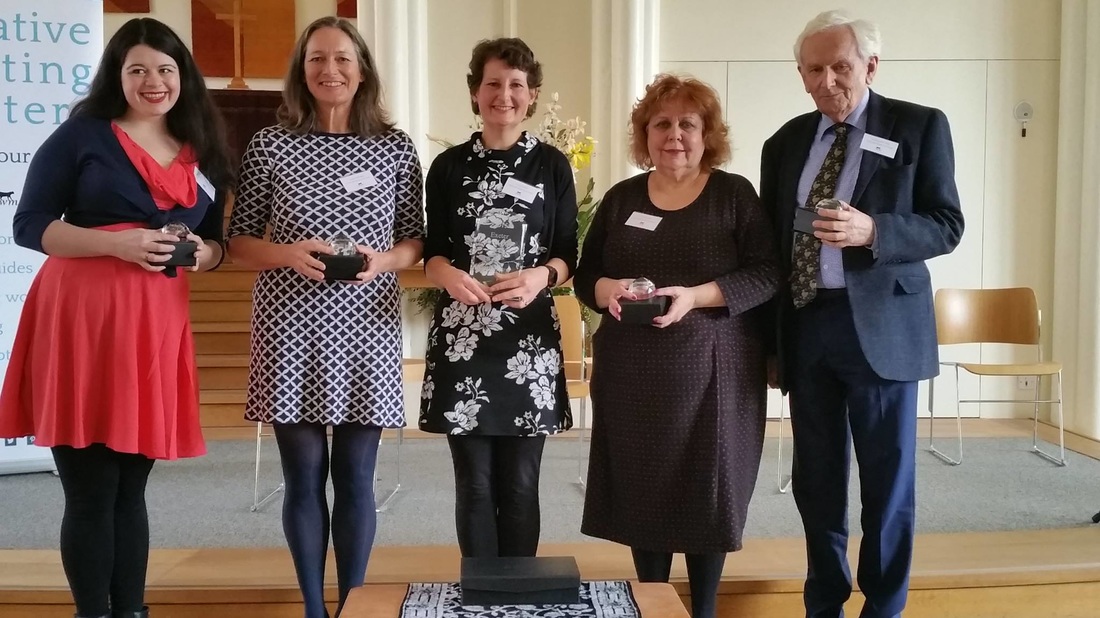
Here are the shortlisted authors. Left to right: Lucy Ayrton, Louise Mangos, Lucy Welch, Lizzie Lamb and Christopher Holt. Mark Dlugash couldn't join us because he was in Los Angeles. Maybe next year, Mark?
We all convened at the historic St Stephen's Church to find out who had won the third Exeter Novel Prize. It's always a tense time, waiting to find out who has won a competition. But, before we announced the winner, we had to make the point that all six of our shortlisted authors were winners because being in the last six out of 340 surely makes you a winner?
So - huge congratulations to Lucy Welch, Lucy Ayrton, Louise Mangos, Lizzie Lamb, Mark Dlugash and Christopher Holt for doing so well, and an additional cheer for Lucy Welch who was the winner of winners.
There is a full report and also a lot of pictures on the CreativeWritingMatters website, so do please pop over and take a look?
www.creativewritingmatters.co.uk
Here are the shortlisted authors. Left to right: Lucy Ayrton, Louise Mangos, Lucy Welch, Lizzie Lamb and Christopher Holt. Mark Dlugash couldn't join us because he was in Los Angeles. Maybe next year, Mark?
Friday, February 19, 2016
Exeter Novel Prize - the Short List
At last, the short list...
After a very lengthy reading and judging process, the finalists in the Exeter Novel Prize 2015 can be revealed. Congratulations to you all and congratulations also to the people on the long list. We had literally hundreds of entries from all over the world. So, for your novel to be in the final few is an outstanding achievement of which you should be very proud indeed.
The Exeter Novel Prize 2015 Short List
A Place in Tumaini - Lucy Welch
Heroine - Lucy Ayrton
Orphaned Leaves - Christopher
Holt
Scotch on the Rocks - Lizzy Lamb
Strangers on a Bridge - Louise Mangos
The Fastest Girl in Red Hook - Mark
Dlugash
The finalists, who come from all four corners of the UK as well as from New York and from Switzerland, will each be presented with an engraved glass trophy. The winner will receive £500 and the runners-up will all receive £75. The members of the CreativeWritingMatters team are looking forward to the awards event on 12 March 2016 in (where else) Exeter, and we are hoping all the finalists will be able to attend in order to collect their awards and have a glass of something sparkling with us!
The London literary agent Broo Doherty will present the awards and tell us what made one particular entry stand out as the winner. We hope the third winner of this award will follow in the footsteps of the first two, Su Bristow and Clare Harvey, who are now both under contract to mainstream commercial publishers.
The awards event is public, so anyone who would like to come is very welcome. There are full details on the CreativeWritingMatters website at www.creativewritingmatters.co.uk.
We're looking forward to a great day!
Sunday, January 24, 2016
Exeter Novel Prize - the Long List
Yes, it's a while since I've posted anything on this blog, so what have I been doing?
I've been reading - thousands and thousands and thousands of words, because of course all the entries were read from the first word to the last - for the Exeter Novel Prize 2015. This will be awarded at a ceremony in Exeter in March 2016. The ceremony is a public event to be held in the historic St Stephen's Church in the centre of Exeter on 12 March at 3 pm, and everyone is welcome!
Today, the long list is posted on the CreativeWritingMatters website, which you can find at http://www.creativewritingmatters.co.uk/.
So how did we (the members of the CreativeWritingMatters team, Cathie Hartigan, Sophie Duffy and I) choose the long list?
We read in a spirit of optimism. We hoped every entry would deliver a great story written in an engaging voice which was right for its genre or sub-genre. This isn't to say we were looking for genre fiction only - please don't think that! Literary, commercial, traditional, experimental - we were looking for excellent writing that invited us into the world of the story and made us want to stay there. We wanted to be sad when we found we'd read a whole entry and couldn't read any more.
We looked for stories which seemed likely to keep their promises - which asked interesting questions and suggested their authors would offer readers satisfying resolutions.
There were quite a few entries which did these things very successfully but didn't make the final long list. Those below are the entries which also had that very special something.
We're relieved we don't have to choose the short list, which is London literary agent Broo Doherty's job!
Congratulations to the authors of the entries listed below.
We will be revealing the names of the authors when we announce the short list. All the reading and judging is done anonymously. So, if your own entry is there, please don't shout out yet!
A Mole of Sorts
A place at Tumaini
Afterwards
Cloud Cover
Down by the Riverside
Going Back
Heroine
Holly and Ivy
Large is the Smallest We've Got
Locks
Orphaned Leaves
Prodigal Honey
Scotch on the Rocks
Strangers on a Bridge
The Chernobyl Privileges
The Fastest Girl in Red Hook
The Last Tiger
The Staircase on Calle Mayor
The Whole Truth
Whirligig
I've been reading - thousands and thousands and thousands of words, because of course all the entries were read from the first word to the last - for the Exeter Novel Prize 2015. This will be awarded at a ceremony in Exeter in March 2016. The ceremony is a public event to be held in the historic St Stephen's Church in the centre of Exeter on 12 March at 3 pm, and everyone is welcome!
Today, the long list is posted on the CreativeWritingMatters website, which you can find at http://www.creativewritingmatters.co.uk/.
So how did we (the members of the CreativeWritingMatters team, Cathie Hartigan, Sophie Duffy and I) choose the long list?
We read in a spirit of optimism. We hoped every entry would deliver a great story written in an engaging voice which was right for its genre or sub-genre. This isn't to say we were looking for genre fiction only - please don't think that! Literary, commercial, traditional, experimental - we were looking for excellent writing that invited us into the world of the story and made us want to stay there. We wanted to be sad when we found we'd read a whole entry and couldn't read any more.
We looked for stories which seemed likely to keep their promises - which asked interesting questions and suggested their authors would offer readers satisfying resolutions.
There were quite a few entries which did these things very successfully but didn't make the final long list. Those below are the entries which also had that very special something.
We're relieved we don't have to choose the short list, which is London literary agent Broo Doherty's job!
Congratulations to the authors of the entries listed below.
We will be revealing the names of the authors when we announce the short list. All the reading and judging is done anonymously. So, if your own entry is there, please don't shout out yet!
A Mole of Sorts
A place at Tumaini
Afterwards
Cloud Cover
Down by the Riverside
Going Back
Heroine
Holly and Ivy
Large is the Smallest We've Got
Locks
Orphaned Leaves
Prodigal Honey
Scotch on the Rocks
Strangers on a Bridge
The Chernobyl Privileges
The Fastest Girl in Red Hook
The Last Tiger
The Staircase on Calle Mayor
The Whole Truth
Whirligig
Sunday, November 29, 2015
Meeting Alex Dunn, whose debut YA novel has just been published
Hello Alex
It’s lovely to have you here on my blog today. Do help
yourself to a slice of Christmas cake. I’ll just get the coffee on and then
let’s talk about your lovely new novel for The Red Telephone Press: The
Demon Magician.
Please tell us about the genesis of this novel – who or what
inspired it?
AD: As you know, Margaret, I love to write, so when someone
told me about NaNoWriMo - an annual internet-based creative writing project to complete
a 50,000 word novel during month of November - I knew the only way I could do it
was to write about something I knew well.
My parents, and my mother in particular, loved horror and she introduced
me to that genre very early in life.
Some of my fondest memories are staying up late on Friday night to watch
the Hammer Horror films, Mum reading Edgar Allen Poe to me, and listening to old
radio plays (in particular The Man in
Black). This, combined with some of my other passions: gothic music, fashion
and a good-looking, charismatic demon with a wicked sense of humour, is how The Demon Magician came about. I simply
wrote about what I loved, all mixed up with love, humour and lots of drama.
MJ: When and where is The
Demon Magician set, and why?
AD: It’s set in present day, in a small town fictional town
somewhere in the south of the UK . Ultimately, when writing horror, fantasy or
science fiction, you have to ground the story in a reality your reader can
relate to. Hence a normal town, with
normal shops and a girl-next-door heroine leading a normal life - that is, until
she meets the Demon Magician…
MJ: The book has a gorgeously spooky cover featuring cadaverous
hands and a hooded creature with a single red eye. Did you play any part in its
design? What does the cover say about the story?
AD: I did have a hand in the design so I’m glad you asked me
this. I brainstormed several ideas with
an online designer and ultimately agreed on the lone image of a dark magician
because it was the most powerful visual that summed up the story. Jonathan is a magician gone bad. He’s in servitude to Belphegor, one of the
seven archdemons of Hell, and lives his life in the shadows. The cover needed to show him because he is at centre
stage of all the events. I especially loved the font that was used and I’m very
proud of myself finding it using a font search tool.
MJ: Who is your ideal reader for this novel?
AD: It is being marketed as a YA Fantasy Horror and would
appeal to anyone who loved The Demonata series, The Vampire’s Assistant by
Darren Shan, Charmed, and my personal
favourite Buffy the Vampire Slayer. That
said, I’ve always read YA and thoroughly enjoyed it. Thanks to a recent
marketing survey, I’ve discovered I’m not alone because an increasing number of
adults are now enjoying YA, which is one of the fastest-growing literary genres.
MJ: You’ve written the novel in the first person. Do you
feel the first person viewpoint is the most appealing and do you always use it?
Or was it merely right for this story?
AD: First person was right for this story. If it wasn’t
written in first person, you’d have no sympathy with Ella when she knowingly takes
a gift from a demon, or be able to experience the conflict with her on such a
personal level when she realises she has to stop Jonathan who used to be the
love of her life. You need to hear her
inner voice at all times – it’s what drives the story forward and sucks you
into the magic underworld of demons and black magic.
MJ: You live in Hong Kong . Does Hong
Kong inspire your fiction? Or, when you write fiction, are you
escaping from Hong Kong ?
AD: You can’t help but be inspired by Hong Kong . It is amazing, and I can’t believe how lucky
I am to be living here. We have ultra modern buildings, luxury shopping malls
and spas built on top of and squashed between markets, temples, local medicine
shops, lovely little tea houses and more restaurants per square foot than
anywhere else on this earth, I’m sure of it. There’s also amazing countryside,
beaches and some beautiful little islands, which are like stepping back in time
– we’ve even got our own Gold Coast! It is a hundred different places in a
relatively small surface area, with every nationality all somehow living in
harmony. However, it’s the Hong Kong people’s spiritual
beliefs and rituals that tend to inspire my writing. They are a very superstitious people – 8 is
lucky, 4 very unlucky (we have no fourth floor on any building). When things weren’t going so well for me at
work, one of my friends put curly bamboo on my desk to help change my luck and
there are rituals to honour the dead.
What I really love is their temples.
You go there to pray for good luck, and if the prediction is bad, you
burn it in the fires and leave all your bad luck behind, and if it is good – you
take it with you. You can’t lose!
MJ: What is next for Alex Dunn, fiction-wise?
AD: I’ve several other YA fantasy novels almost completed,
but the one I am racing to finish is another demon story. This time it’s about a demon who opens a spa
and makes people thinner, younger and prettier in return for their souls. It’s a lot of fun and quite topical given the
obsession we all seem to have with outward appearance. I’m also able to draw on my own diet
experiences that are extensive and not all of them successful. J
MJ: You’ve successfully published your first novel. What
advice would you give a new writer just setting out on the journey you took?
AD: Be patient, because getting a book to print is a marathon not a
sprint. It takes time to edit, time to
make revisions, time to see if marketing strategies work – it even takes a long
time to do fun things like the cover. Patience is a mandatory requirement for
all authors.
MJ: Do you feel everyone has the potential to become a
storyteller? Or are storytellers born
rather than made?
AD: I believe we all have it in us to write a story, but not
everyone can tell one. I listen to a lot
of audio stories when I work out, and love listening to the likes of Stephen
Fry, Rik Mayall, or John Hurt. They
perform the story. They make it come alive, and it’s the next best thing to
reading the pages yourself.
Five Quick Questions
Do you prefer:
Animals or people?
Err, that’s a tough one, but I’ve never met an animal I
didn’t like so I’ll have to say them, although that doesn’t mean I don’t like
most people I meet, too.
City or country?
City – I like convenience and excitement.
Company or solitude?
Solitude, but only because it’s a luxury these days.
Exercise or the sedentary life?
Sedentary – I go to the gym but I don’t enjoy it.
Ship or plane?
I really don’t mind as long as it’s first class. J
Thank you, Alex – it’s been great to chat to you! Good luck
with this novel and with many more to come!
Wednesday, October 21, 2015
Madness and mystery in Naples and Devon - chatting to Cathie Hartigan about her debut novel Secret of the Song
Hello, Cathie - welcome to my blog on this rainy morning!
I'm delighted you've agreed to chat to me about your debut novel Secret of the Song, a time slip story set in Renaissance Naples and 21st century Devon.
MJ: What was the original inspiration for this novel?
CH: A few years ago when I
was in a small choir we were given a song to sing by Carlo Gesualdo, one of the
main characters in my book. I’d never heard of him. The music was difficult and
we all got very grumpy. Although the music was written back in the 16th century, it
sounded very discordant, almost avant garde. The choirmaster then told us about
Gesualdo’s notoriety. When I did some research into his life, I was hooked.
MJ: What particularly attracted you to writing a time slip
story?
CH: It was at the same
rehearsal that I first wondered whether madness could be somehow transmitted in
music such that it affected the musicians who performed it. When I think of
those ‘maddening’ tunes that seem to go round and round in the head for days on
end, earworms they’re called, then it seems quite likely. I thought I would
write a contemporary novel about a singer finding out about Gesualdo and then
wondering if a piece of music could be cursed, but when I read the witness
statement by young Silvia Albana, I was so taken by her plight, that I decided
to interweave her story. She was the seamstress and confidant to Gesualdo’s
wife, a princess who behaved so recklessly that she endangered both herself and
poor Silvia.
MJ: How do you work – are you a planner and are you most
definitely in charge, or do you let your characters guide you into their
stories and do you take your cues from them?
CH: I have a plan but it
isn’t very exact, although I do know what the big questions are that I’m trying
to answer. Writing a few chapters in order to really immerse myself in the
world helps me too, and I get to know the characters more thoroughly. That’s
usually when I pause and tighten up the plan.
MJ: As a classical musician and singer yourself, do you feel you
have a mission to encourage more people to take an interest in classical music
and – if so – was this one of your motives for writing this novel?
CH: I certainly felt I had
a mission when I trained to be a music teacher but that was quite a long time
ago. Now I think the best way to encourage anyone to do or enjoy anything is to
be passionate about it. I absolutely love singing the sort of music I have
written about and if I can enthuse my readers to go and listen to (or better still,
sing) any Italian or English songs written during Tudor times, it would be
fantastic.
MJ: Who is your favourite character in Secret of the Song?
CH: That’s very difficult
because I’m so fond of several, but I think it’s got to be Mollie. She’s the
precocious ten year-old daughter of Lisa, my contemporary heroine. There’s
considerable negotiation that goes on between mother and daughter. There’s one
particular scene I’m fond of where Mollie has a secret and Lisa is trying to
find out what it is, even though she’s always told Mollie that secrets
shouldn’t be revealed.
MJ: Do you have any tips for people starting to write a first
novel?
CH: Ask yourself what your
novel is about and keep asking until you can answer with confidence when
someone asks you. Try practising on already published novels.
Think about your plot
in terms of scenes. Start each one with intrigue and end with sufficient
jeopardy (not necessarily life-threatening) to make your reader want to turn
over.
Five quick questions
Do you feel more at home in a town or in the countryside?
I’ve lived in both and
while I’m now more at home in a city, I do miss having the breathtaking beauty of
the Devon countryside on my doorstep.
If you could live anywhere in the world, where would it be?
I love Devon so it
would have be here, and I’m not a great traveller, but a small pad in London
and perhaps the Dordogne, and somewhere near Florence, and maybe by the Med…
Who are your favourite composers?
I keep coming back to
Bach when I play the piano, but I have a very eclectic mix of music on my
phone. All sorts from the Renaissance period, but I also have Mozart, Brahms,
Puccini, and quite a few albums by Pat Methany, the jazz guitarist.
Do you feel any other writers particularly influence your
work?
I think all my reading
has influenced me, but I remember loving a book by Barbara Trapido and
thinking, she can turn the emotion on a pin. She could do funny and serious
equally quickly and yet it didn’t jar. Could I do that?
What’s next on the writing agenda for you?
Thank you, Cathie - it was good to talk. Many congratulations on the publication of this lovely novel, and here's to great sales now and in the future!
http://www.amazon.co.uk/Secret-Song-Cathie-Hartigan/dp/1517114284/ref=cm_cr_pr_product_top?ie=UTF8
Friday, October 9, 2015
Sophie Duffy talks about her latest novel
Bright Stars is Sophie Duffy's new novel, out this month and already twinkling in the Amazon skies! I caught up with Sophie yesterday when we had a coffee in the Debenham's cafe overlooking Exeter Cathedral, and we had a lovely chat about Sophie's story. It features four friends who were at university together and whose later lives don't quite work out in the way they might have expected - or planned.
MJ: I see this novel is
partly set at Lancaster University . So
were you a student there yourself and is this story based on any of your own
experiences?
SD: Yes, I studied English there from 1986 to 1989 and I
borrowed heavily from the landscape there at that time, both geographical and
political. But the story and characters are most definitely fiction. I later got
an MA in Creative Writing which I studied for by distance learning. It was
strange going back for summer school and revisiting old haunts. Lancaster
University is going from strength
to strength and I think it’s quite a unique place to study. As long as you
don’t mind wind and rain.
MJ: Where did the
character of Cameron come from – did he walk into your head and say write about
me, is he based on anyone you know?
SD: I wrote the first draft of Bright Stars in the third
person from four points of view - Bex's, Tommo's, Christie's and Cameron’s. I wanted to show how
four completely different people can become friends when they are thrown
together in a confined space. But something didn’t quite work. Someone asked me whose story it was and that made me realise it was
indeed Cameron’s story. So I didn’t set out to write in a Scottish man’s voice
but that’s how it ended up.
MJ: How did you get into
the mindset of a man?
SD: Cameron’s not a testosterone-fuelled man. He’s a sensitive
soul. Doesn’t like sport or beer. He’s a little quirky and different and that’s
the kind of character I like writing about, so I just went with it.
MJ: What’s your favourite
part of the creative writing process?
SD: The last quarter of writing a novel, when it all starts to
come together and makes a whole. I love it when that happens but it is a slog
getting there.
MJ: Who are your own
favourite authors and have any of them influenced your own writing?
SD: I love the Thomas Hardy and George Eliot – their use of
flawed, complex characters has definitely informed my writing. I also love
writers who use a sense of humour to show the extraordinary in the ordinary –
David Lodge, Kate Atkinson, Barbara Pym are my favourites.
MJ: You’re a very
successful contemporary novelist. Do you have any ambitions to write historical
fiction?
SD: I would love to write an historical novel. In fact, my
current work-in-progress begins in the 1920s, so I am creeping backwards… I
would also love to write a ghost story and am mulling over some ideas.
MJ: What are you working
on now?
SD: I’m writing about the life of a female undertaker – a
profession that has always fascinated me. Not that I am morbid or anything.
MJ: As a prize-winning
author who is also involved in mentoring and judging the work of other creative
writers, do you have any tips for people just setting out on their creative
writing journeys?
SD:
- Do a writing class or join a writing group.
- Read lots of current books.
- Just write. Anything and everything. You have to write a lot of rubbish until something good bubbles up.
MJ: Thank you, Sophie - it was good to chat!
Subscribe to:
Posts (Atom)